
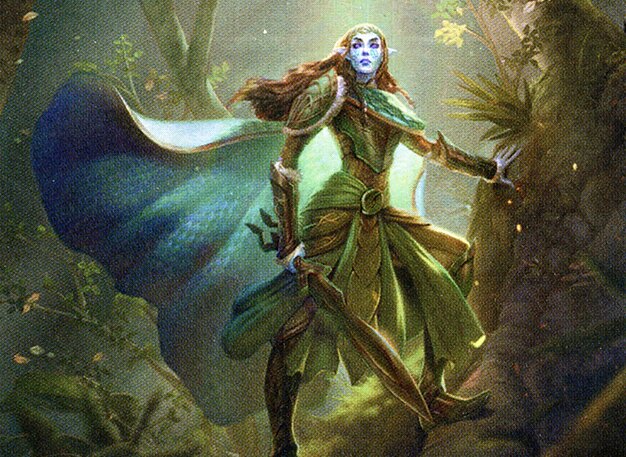
Ten untapped Elves plus Lathril is the signature kill. Her ability reads “{T}, Tap ten untapped Elves you control: Each opponent loses 10 life and you gain 10 life.” One activation is a 10-point drainA drain takes life from opponents and hands it to you in the same effect, no combat involved. on every opponent at once: across a three-opponent table that is 30 life gone and 10 gained, no attack declared, no blockers in the math. And it repeats every turn you can reassemble ten untapped Elves. Elvish Promenade and Elven Ambush each make a 1/1 Elf Warrior for every Elf you control, so one spell rebuilds the count; Lys Alana Huntmaster and Elvish Warmaster grow it passively; Wolverine Riders adds a token on every upkeep, not just yours. The ability is also instant speed, so if a board wipe is coming and the ten are there, drain in response and take the 30 on the way out. Two activations plus incidental combat is most of the table’s life, which is why the kill window sits at T8 to T10.
TAP TEN ELVES. drain the table.
Hunter's Golgari elf tribal on Lathril, Blade of the Elves: flood the board with Elves, then tap ten of them to drain 10 life from each opponent and gain 10 back, or stack the lords and Coat of Arms and swing over the top.
Lathril, Blade of the Elves is a Golgari elf tribal deck that goes wide, then drains the table without asking combat for permission.
Full gameplan
The commander is a four-mana 2/3 with menace, and when she deals combat damage to a player she creates that many 1/1 green Elf Warrior tokens, so every connect grows the board on its own. Those tokens feed her second line, the reason the deck exists: tap Lathril and ten untapped Elves you control, and each opponent loses 10 life while you gain 10. At a three-opponent table that is 30 life in one activation, no attack declared, no blockers in the math, and it repeats every turn you can reassemble ten untapped Elves. The rest of the list makes ten a routine number instead of a magic one. Mana dorks like Llanowar Elves and Elvish Mystic start the count on turn one. Priest of Titania, Elvish Archdruid, Marwyn, the Nurturer, and Wirewood Channeler turn the count into explosive mana. Lys Alana Huntmaster, Elvish Warmaster, Imperious Perfect, Elvish Promenade, and Elven Ambush multiply bodies faster than the table can answer them. Beast Whisperer draws a card for every creature spell you cast, and Skullclamp turns any 1/1 token into two cards for one mana, so the deck refuels while it floods. The lords stack on top: Elvish Archdruid, Imperious Perfect, Canopy Tactician, and Dwynen, Gilt-Leaf Daen each pump the tribe, Pride of the Perfect adds +2/+0, and Coat of Arms hands every Elf +1/+1 for each other Elf on the battlefield, turning the token pile into a one-swing kill. The drain package doubles as reach: Shaman of the Pack hits one opponent for your Elf count when it enters, Skemfar Shadowsage can hit all of them for it, and Poison-Tip Archer bleeds each opponent for 1 whenever another creature dies, so even the board wipe aimed at you costs the table life. Zero Game Changers, zero infinite combos, zero mass land destruction: a fair, linear Bracket 2 deck that does one loud thing and does it well, with a kill window of turn eight to ten. The whole game is a count to ten, and the deck counts fast. You close three ways: the Lathril drain, tap ten Elves and each opponent loses 10 while you gain 10, over and over; a Coat of Arms or End-Raze Forerunners alpha strike; or drain bursts as reach with Shaman of the Pack, Skemfar Shadowsage, and Poison-Tip Archer.
Lathril, Blade of the Elves strategy guide
Lathril, Blade of the Elves is a GolgariGolgari = black plus green. The two colors this deck plays in. Elf Noble who costs {2}{B}{G} as a 2/3 with menace, and her card is the whole gameplan in two lines. The first: “Whenever Lathril deals combat damage to a player, create that many 1/1 green Elf Warrior creature tokens.” The second: “{T}, Tap ten untapped Elves you control: Each opponent loses 10 life and you gain 10 life.” Every other card in the 99 exists to make that second line fire on time, then fire again.
The plan is a count. DorksA mana dork is a cheap creature that taps for mana, like Llanowar Elves. start it on turn one and double as bodies toward ten. Priest of Titania, Elvish Archdruid, Marwyn, the Nurturer, and Wirewood Channeler turn the count into mana. Beast Whisperer and Lys Alana Huntmaster turn every Elf you cast into a card or an extra body. Elvish Promenade and Elven Ambush double the count in one spell. And once the count clears ten, the math stops mattering: tap ten, each opponent loses 10, you gain 10, untap, do it again.
You do not pick a wincon at sleeves-on. You count Elves and take whichever lane the table leaves open.
When the drain is a turn short, go over the top instead. Coat of Arms gives each creature +1/+1 for each other creature that shares a creature type with it, and on a mono-Elf board the math runs away fast: with ten Elves out, every 1/1 token attacks as a 10/10. End-Raze Forerunners is a 7/7 with vigilance, trample, and haste that hands the rest of the team +2/+2, vigilance, and trample the turn it lands, which turns a stalled board into a lethal alpha strikeAn alpha strike is a full attack with everything at once, betting the game on one swing. from nowhere. Under those sit the lordsA lord pumps its whole tribe, like Elvish Archdruid's line: other Elf creatures you control get +1/+1.: Elvish Archdruid, Imperious Perfect, Canopy Tactician, and Dwynen, Gilt-Leaf Daen each give your other Elves +1/+1, Pride of the Perfect adds +2/+0, Timberwatch Elf taps to give one attacker +X/+X for the number of Elves on the battlefield, and Elvish Warmaster’s activation hands the team +2/+2 and deathtouch. One caution: Coat of Arms reads each creature, yours and theirs, so against another tribal deck it is a finisher you cast on the kill turn, not a value drop.
The black half closes out players who hide behind blockers. Shaman of the Pack enters and a target opponent loses life equal to your Elf count, a burst of direct life loss aimed at exactly the player you need gone. Skemfar Shadowsage enters and either each opponent loses X or you gain X, where X is your biggest shared-type count, in this deck your Elves. Poison-Tip Archer bleeds each opponent for 1 whenever another creature dies, so token trades, Skullclamp draws, and even the board wipe aimed at you all cost the table life. Elderfang Venom stacks a second death drain, each opponent loses 1 and you gain 1 whenever an Elf you control dies, and gives your attacking Elves deathtouch on top. The rebuys make the bursts recur: Return Upon the Tide brings an Elf back to the battlefield plus two tokens, and Patriarch’s Bidding returns every Elf creature card in your graveyard to the battlefield at once, re-firing Shaman and Shadowsage the same turn.
Bank tokens, then drain
One sequencing rule decides more games with this deck than every clever line combined.
Opening hand
Keep hands with two to three lands including a green source, a one-mana dork, and one engine piece. Lathril is always on time from the command zone, so the opener’s only job is the board around her. The deck runs 37 lands, 16 of them Forests, so green comes easy, and it is the hands without it that you ship.
Snap keep: land, dork, engine. Two lands with a Forest, Llanowar Elves or Elvish Mystic, and Beast Whisperer, Lys Alana Huntmaster, or Skullclamp. That is the exact curve the deck is built around.
Snap keep: Priest of Titania into payoffs. Priest on turn two is worth four-plus mana by turn four in this deck, and any hand that follows it with a lord or a token maker snowballs.
Keepable: three lands, removal, and a mid-curve engine. Slower, but Harald, King of Skemfar and Sylvan Messenger dig you into the Elves you are missing, and Abrupt Decay or Putrefy buys the time.
Keepable: Sol Ring plus a green land and bodies. Sol Ring opens a turn-two Beast Whisperer or a double-dork start. Keep it if the hand still casts its green spells.
Ship back: no green sources. The first three turns of this deck are green: the dorks cost green, the engines cost green, the commander needs it. A hand of Swamps casts removal and nothing else. Black is the splash here, not the base. Mulligan it, no exceptions.
Ship back: zero or one land, or all payoffs. Coat of Arms and Patriarch’s Bidding in the opener win nothing if the board never develops. You need a play by turn two.
Lead with a Forest into Llanowar Elves or Elvish Mystic. Jaspera Sentinel is the sneaky-good one-drop: it taps itself plus another untapped creature you control for a mana of any color, which fixes your black without a Swamp. Sol Ring hands skip straight to the two-drops. Do not burn a tapped dual on turn one if a Forest does the job.
The Elf count starts on turn one; a dork is mana now and a body toward ten later.Priest of Titania, Marwyn, the Nurturer, or Elvish Warmaster. Priest taps for a green per Elf on the battlefield, Marwyn grows with every other Elf that enters under your control and taps for her power, and Warmaster makes a free token the first time other Elves enter each turn. Skullclamp can land now, but hold the equips until there are tokens to feed it. Two dorks on two is also fine; bodies are never dead here.
Priest of Titania on two can be worth five mana by turn four.This is the most important sequencing turn of the game: land Beast Whisperer or Lys Alana Huntmaster before you dump the hand. Every creature spell after Whisperer draws a card, and every Elf spell after Huntmaster makes a token, so the same five Elves cast in the wrong order are five cards and in the right order are ten. Elvish Archdruid also lands here as a lord plus a mana engine, and Harald, King of Skemfar digs on entry. No engine? Fix the mana with Wood Elves, Farhaven Elf, or Springbloom Druid.
Beast Whisperer or Lys Alana Huntmaster first turns every later Elf into a card or a body.Cast Lathril on curve, a turn early off a dork. She is a 2/3 with menace, so she connects more often than she should, and each point of damage banks a token; with a lord out she swings as a 3/4 and banks three. Lords and token makers fill the rest of the mana: Imperious Perfect, Canopy Tactician, Dwynen, Gilt-Leaf Daen, Pride of the Perfect. Start attacking with her the moment the table’s blockers make it safe.
The commander lands on time and every connect from here banks token fuel.Elvish Promenade or Elven Ambush with six Elves out makes six more, and Ambush does it at instant speed. Wolverine Riders adds a token on every upkeep and gains you life equal to the toughness of each other Elf you land. Shaman of the Pack lands late for a bigger hit, but on five it can still snipe a low seat. Hold Coat of Arms until the turn you intend to kill; it is an artifact and a lightning rod.
Elvish Promenade and Elven Ambush double the board in one card.Take stock. Ten untapped Elves plus an untapped Lathril: drain, each opponent loses 10 and you gain 10. Short of ten: swing with Lathril and the team to bank tokens, untap, drain next turn, and remember the end-step line from the rule above. If the table is wide open instead, Coat of Arms or End-Raze Forerunners turns the same board into an alpha strike. Skemfar Shadowsage and Shaman of the Pack finish whoever the drain left in range. First activation usually lands T7 to T8; the second one, or the wide swing, ends it by T10.
This is the window: bank with a swing, untap, drain, repeat until the table is gone.Mistakes this deck punishes
These are the errors that cost games even when every card is played to its oracle.
Dumping every Elf into open mana. The deck folds to a well-timed board wipe harder than to anything else: the commander needs ten bodies, and one wrath resets the count to zero. The fix: once you are the widest board, hold Heroic Intervention (permanents you control gain hexproof and indestructible) or Wrap in Vigor (regenerate each creature you control), and keep a rebuild in reserve: Patriarch’s Bidding returns every Elf creature card in your graveyard to the battlefield, Return Upon the Tide rebuys one plus two tokens, and Elderfang Ritualist and Golgari Findbroker pull cards back. Poison-Tip Archer makes the wipe cost the table too, one life per opponent for every other creature that dies.
Staking the game on Coat of Arms and Skullclamp surviving. Your two best noncreature pieces are both artifacts, so a single seat with artifact removal answers the pump and the draw engine with the same cards. The fix: treat Coat as a finisher, cast it the turn you swing for the kill, not three turns early as a billboard. Clamp a token the moment Skullclamp lands so the removal is already down two cards. And if Coat dies anyway, the creature half of the pump plan still works: the lords, Pride of the Perfect, Timberwatch Elf, and Elvish Warmaster’s +2/+2 activation all live on bodies.
Counting Patriarch’s Bidding as guaranteed wipe insurance. Graveyard hate blanks it completely, and it is a sorcery you cast on your own turn, not a shield. The fix: against known graveyard hate, pivot to the battlefield-side rebuild, token makers plus Elvish Warmaster, and lean on Heroic Intervention to never need the yard at all. Read the other graveyards before you cast it, too: Bidding lets each player return a chosen type, so firing it into a Zombie deck refills their board along with yours.
Clamping the wrong Elf, or not clamping at all. Skullclamp gives +1/-1 and draws two cards when the equipped creature dies. On a 1/1 Elf Warrior token that is two cards for one mana, on demand, every token, and it is how the deck out-draws tables that think it is all gas. The mistake is clamping Priest of Titania or a fresh Marwyn, killing your own mana engine for the same two cards, or letting the Clamp sit idle while you flood. The fix: clamp tokens, keep the real Elves alive, and stack the death payoffs: with Elderfang Venom or Poison-Tip Archer out every clamp death also drains the table, and Miara, Thorn of the Glade turns those same deaths into extra cards.
Tapping the wrong ten. Priest of Titania taps for a green per Elf on the battlefield (it counts everyone’s Elves), Elvish Archdruid for each Elf you control, Wirewood Channeler for the battlefield count in any one color, and Marwyn for her own power. The mistake is tapping your mana Elves into Lathril’s drain cost, or draining first and stranding a hand you can no longer cast. Every Elf pays one bill per turn: the drain or mana, not both. The fix: count before you tap. Pick the ten that pay the drain, tap the mana engines for the rest of your hand first, and spend the explosion turns double-spelling, an Archdruid turn should cast the dump and Elvish Promenade, or an End-Raze Forerunners a turn early. Remember the other outlets compete for the same bodies: Nullmage Shepherd taps four untapped creatures to destroy an artifact or enchantment, Jaspera Sentinel taps one, Timberwatch Elf taps itself.
Note on the list. Zero Game Changers: Skullclamp is not a Game Changer and Sol Ring is exempt. No infinite combos, no two-card kills, no mass land destruction, no extra turns. The two non-Elves in the deck are End-Raze Forerunners, a Boar that carries its own finish by pumping the rest of the team the turn it lands, and Super Shredder, a two-mana menace that gains a +1/+1 counter whenever another permanent leaves the battlefield, so the steady churn of token deaths, Skullclamp sacrifices, and trades grows it into an evasive second clock even though the Elf lords and Coat of Arms never touch it. The deck says exactly what it does at rule zero: it makes Elves, and once ten of them stand untapped, everyone else loses 10.
MTG terms that show up above.
Open glossary
- Game Changer
- A specific card on Wizards' published Game Changer list. Bracket 2 builds generally run zero. Bracket 3 caps at 3.
- Bracket
- The published power-tier system for Commander: 1 (precon), 2 (casual), 3 (upgraded/standard), 4 (high-power), 5 (cEDH).
- Equip
- An activated ability on an Equipment card. Pay the equip cost, attach to a creature you control. Sorcery speed only.
- Vigilance
- A creature with vigilance doesn't tap when it attacks. Common in white. Often granted by static effects (Brave the Sands) or equipment (Shadowspear).
- Mulligan
- Shuffle your hand back, draw 7 again. Standard EDH mulligan: each successive mull, put one card on the bottom at the end of the process (the 'London' mulligan).
All 100 cards.
Draw a mountain of cards, sit on 11, then swing with Eleven and cast a one-sided wipe or an alternate win for free. Mike recycles creatures that die and gives Eleven a tax-free comeback.
Orzhov Elder Dragon commander, 4-mana 4/4 flying vigilance who gives every instant and sorcery you cast Casualty 1. Sacrifice a power-1+ creature on cast, copy the spell, pick new targets. Bracket 3 sac-engine voltron with a token suite, equipment kit, and recursion. Zero Game Changers, no infinite combos.
Custom builds, cEDH lists and stock precons, filtered by colour, bracket or commander.